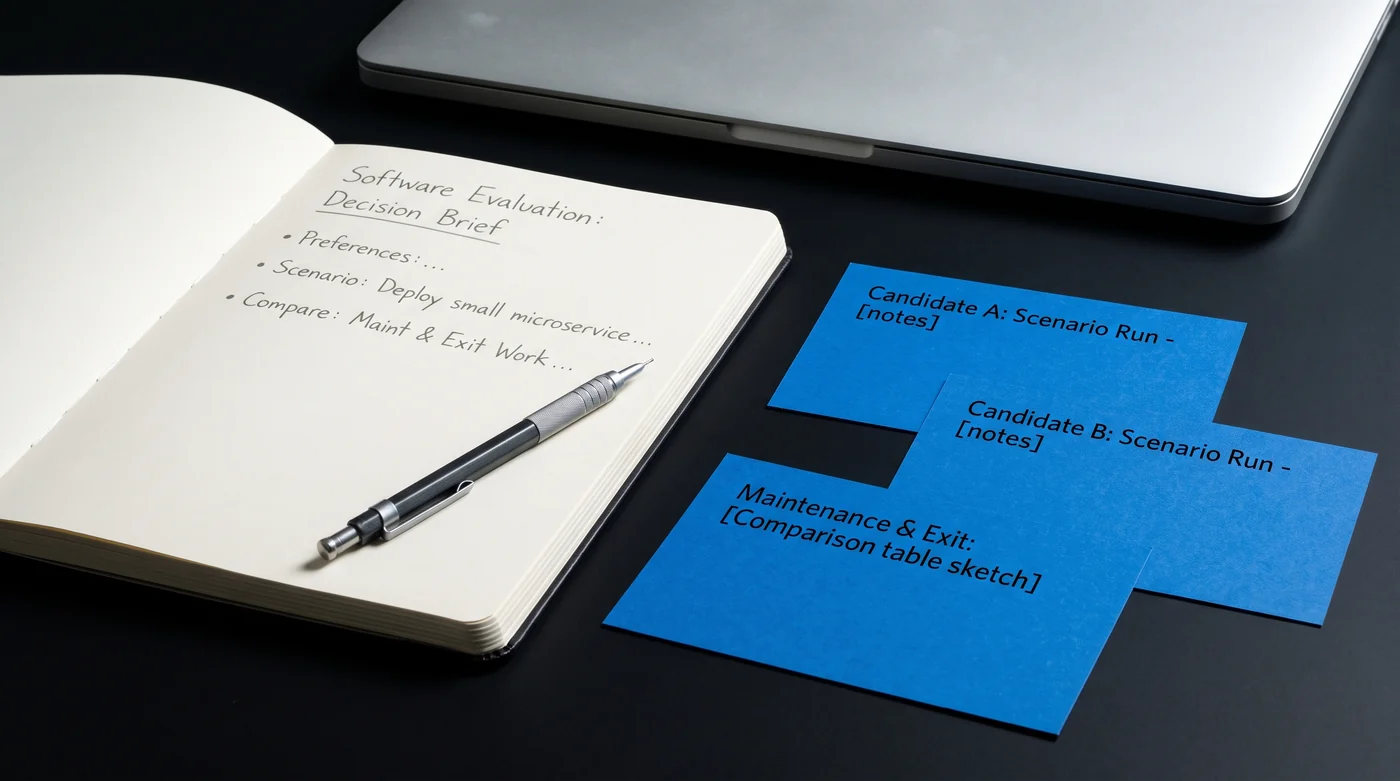
Turn preferences into a decision brief
Write the workload, required capabilities, constraints and reasons an option would be ruled out. Separate a required regional data arrangement or export format from a preferred interface detail. A shortlist becomes more useful when another person can explain why each option remains on it. Keep the same brief for every candidate so a polished demo does not quietly change the comparison.
Run the same small scenario on each candidate
Prepare synthetic input with an ordinary case and the important exceptions. Define expected results before the trial. Record the product, plan, version where available, date and configuration. Keep the resulting receipts or screenshots with a written observation. If a feature is documented but untested, label it that way; a vendor claim and your own result are different evidence.
Compare maintenance and exit work
Inspect how failures are found, mappings edited and credentials owned. Try an export and identify which dependencies the export does not include. A workflow file may omit connections, permission settings, stored state or external assets. Portability is a set of practical handoffs to verify, especially when one publication may be sold independently.
Keep commercial relationships beside the evidence
An affiliate program can make a tool commercially relevant without making it suitable for the workload. Retain non-affiliate options when they meet the brief. Our software collection identifies the questions still to check. Labelled Higgsfield links use affiliate tracking; other providers remain ordinary references. Approval for a program, a published commission rate and an observed product result are three separate records.
Keep these details together.
- Required capabilities versus preferences
- Trial inputs and pass criteria
- Exit path and portable exports
Go a little deeper.
Use the publication’s reference library to connect the task to the relevant constraints.
Workflow Library ↗